Summer Activities for Kids 2026: Why Physical Activity Beats Screen Time (And How Hula Hoop Makes It Fun)
 Pooja Agrawal
The Summer Screen Time Crisis: What Every Parent Needs to Know
It’s March. Summer vacation is around the corner. And if you’re like 85% of Indian parents, you’re already dreading the inevitable: your child glued to a screen for 6+ hours a day.
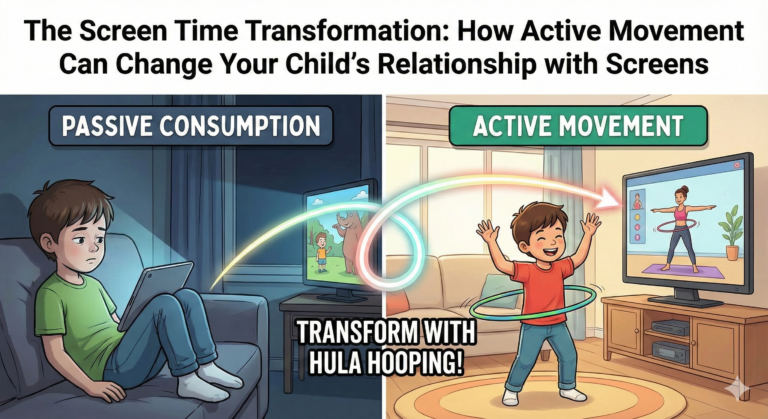
Here’s the uncomfortable truth — 69% of children in India spend more than 3 hours daily on screens, well above the recommended limit. During summer, when school structure disappears, that number skyrockets. The result? Restless kids, frustrated parents, and a vacation that feels more like a battle than a break.
But what if summer could be different? What if there was an activity that gets kids moving, builds real confidence, and is so much fun they actually choose it over their tablet?
That’s exactly what this guide is about. We’ll walk you through why physical activity is the single best investment you can make in your child’s summer — and introduce you to an activity that’s transforming how kids spend their holidays across India, the UAE, and beyond.
Why Physical Activity Should Be Your Child’s #1 Summer Priority
We all know exercise is “good for kids.” But the science behind it is far more compelling than most parents realise.
Brain Development
Physical activity doesn’t just build muscles — it builds brains. Studies show that children who engage in regular physical activity have better memory, sharper focus, and stronger problem-solving skills. Movement increases blood flow to the brain, stimulating the growth of new neural connections. Summer is when kids have the time to develop these pathways — don’t waste it on passive consumption.
Emotional Resilience
Learning a physical skill — whether it’s catching a ball, holding a yoga pose, or spinning a hula hoop — teaches children something screens never can: how to fail, try again, and eventually succeed. This cycle of struggle and mastery builds grit. It builds confidence that comes from doing, not watching.
Social Skills
Even in online group classes, physical activities create real social bonds. Kids cheer each other on, share tips, and celebrate milestones together. These connections are fundamentally different from the isolated interactions of gaming or social media.
Sleep and Mood
Active kids sleep better. They’re calmer, less irritable, and more cooperative. If your summer mornings currently start with screen-time negotiations, physical activity is your secret weapon to peaceful, structured days.
Top Summer Activities for Kids in 2026: An Honest Comparison
Not all summer activities are created equal. Here’s a realistic breakdown of the most popular options — what they cost, what they deliver, and what parents actually report:
1. Coding and STEM Classes
- Pros: Future-relevant skills, structured curriculum
- Cons: More screen time (the very thing parents want to reduce), can feel like “school during holidays”
- Best for: Kids who genuinely enjoy tech (not every child)
- Reality check: 96% of parents searching for summer activities are specifically looking for screen-free alternatives
2. In-Person Summer Camps
- Pros: Outdoor exposure, socialisation, variety
- Cons: Expensive (₹5,000-15,000/week), limited to metro cities, heat concerns in April-May
- Best for: Families in cities with good camp options and flexible schedules
- Reality check: Indian summers regularly cross 42°C — outdoor camps often get cancelled or shortened
3. Art and Craft Classes
- Pros: Creative expression, minimal screen time if offline
- Cons: Sedentary (doesn’t address the physical activity gap), supplies add up
- Best for: Kids who love creating, as a complement to physical activities
4. Dance and Movement Classes (Online)
- Pros: Physical activity + creativity, accessible from anywhere, fun music
- Cons: Quality varies wildly, many lack structured progression
- Best for: Kids who love music and movement — especially if the class has a clear skill-building path
5. Hula Hoop Classes (Online)
- Pros: Full-body workout, builds coordination and rhythm, clear level progression (beginner to advanced), works indoors in any weather, affordable, props make it feel like play not exercise
- Cons: Needs a hula hoop (₹200-500) and some room to spin
- Best for: Ages 4-18, kids who resist “exercise” but love challenges and performance
- Why it stands out: Combines fitness + dance + skill mastery in a way no other online activity does
Hula Hoop as a Summer Activity: Why It’s Having a Moment
Ten years ago, hula hooping was something your grandparents did in the park. Today, it’s a structured performing art with levels, choreography, and competitions — and it’s one of the fastest-growing online activities for kids in India.
Here’s why hula hooping is uniquely suited for summer:
It’s Indoor-Friendly
When it’s 43°C outside, your child can still get a full workout in your living room. All they need is a hula hoop and enough space to extend their arms. No playground required, no sun exposure, no cancelled plans due to weather.
It Doesn’t Feel Like Exercise
Kids don’t think of hula hooping as “working out” — they think of it as doing cool tricks. This is the secret. When exercise feels like play, kids do it willingly. No nagging required.
Structured Skill Progression
Unlike free-play activities, hula hoop classes follow a level system. At HoopStar Academy, students progress through 6 levels — from basic waist hooping to advanced multi-hoop choreography. Each level has clear goals, giving kids a sense of achievement and motivation to keep going.
It’s a Full-Body Workout
Hula hooping engages your core, legs, arms, and back simultaneously. A 30-minute session burns as many calories as a brisk walk, while also improving:
- Core strength and posture
- Hand-eye coordination
- Balance and spatial awareness
- Rhythm and musicality
- Flexibility
It Builds Performance Confidence
Hula hooping is visual and impressive. When a child masters a new trick, they want to show everyone. This natural desire to perform builds presentation skills, stage confidence, and self-esteem — skills that transfer to school presentations, social situations, and beyond.
Benefits of Hula Hooping for Kids: What the Research Says
Hula hooping isn’t just fun — it’s backed by real benefits that parents (and pediatricians) care about:
Physical Benefits
- Cardiovascular fitness: Sustained hooping elevates heart rate, improving endurance over time
- Core strength: The constant rotation engages abdominal and back muscles, building a strong core that supports good posture
- Motor skills: Catching, tossing, and manipulating the hoop develops fine and gross motor coordination — especially important for ages 4-8
- Flexibility: The range of movements involved in tricks and choreography naturally increases flexibility
Cognitive Benefits
- Focus and concentration: Learning sequences and routines requires sustained attention — a skill that directly transfers to academics
- Memory: Remembering choreography strengthens working memory
- Bilateral coordination: Many hula hoop moves require both sides of the body to work independently, strengthening brain connectivity
Emotional Benefits
- Stress relief: The rhythmic, repetitive motion of hooping has a meditative quality that reduces anxiety and exam stress
- Self-efficacy: Mastering a trick that seemed impossible yesterday builds real, earned confidence
- Creative expression: As skills advance, students create their own routines — a powerful outlet for self-expression
Hula Hoop Size Guide by Age: Getting the Right Fit
One of the most common questions parents ask is: “What size hula hoop does my child need?” Getting the right size is crucial — a hoop that’s too small or too heavy will frustrate beginners and make learning harder.
Here’s a quick reference guide:
| Age Group | Recommended Diameter | Weight | Notes |
|---|---|---|---|
| 4-6 years | 24-28 inches | Light (100-150g) | Smaller, lighter hoops for small bodies. Focus on fun, not technique. |
| 6-10 years | 28-32 inches | Medium (150-250g) | Standard kids’ size. Should reach between waist and chest when standing upright. |
| 10-14 years | 32-36 inches | Medium (200-300g) | Transitional size. Some advanced students may prefer adult-sized hoops. |
| 14-18 years | 36-40 inches | Medium-Heavy (250-400g) | Near-adult size. Weight helps with sustained waist hooping. |
| Adults (18+) | 38-42 inches | Medium-Heavy (300-500g) | Larger diameter = slower rotation = easier for beginners. |
Pro tip: When in doubt, go slightly larger. A bigger hoop rotates more slowly, giving beginners more time to find their rhythm. You can always size down as skills improve.
Where to buy: At HoopStar Academy, we help every enrolled student find the right hoop — we recommend specific brands and sizes based on your child’s age, height, and level.
Online vs Offline Hula Hoop Classes: Which Is Better?
This is a debate we hear often. Let’s be honest about the trade-offs:
Offline / In-Person Classes
- Advantages: Hands-on corrections, social interaction, dedicated space
- Challenges: Limited availability (few cities offer hula hoop classes), travel time, weather disruptions, higher cost, fixed schedules
- Best for: Families who live near a hula hoop school and prefer in-person instruction
Online Classes
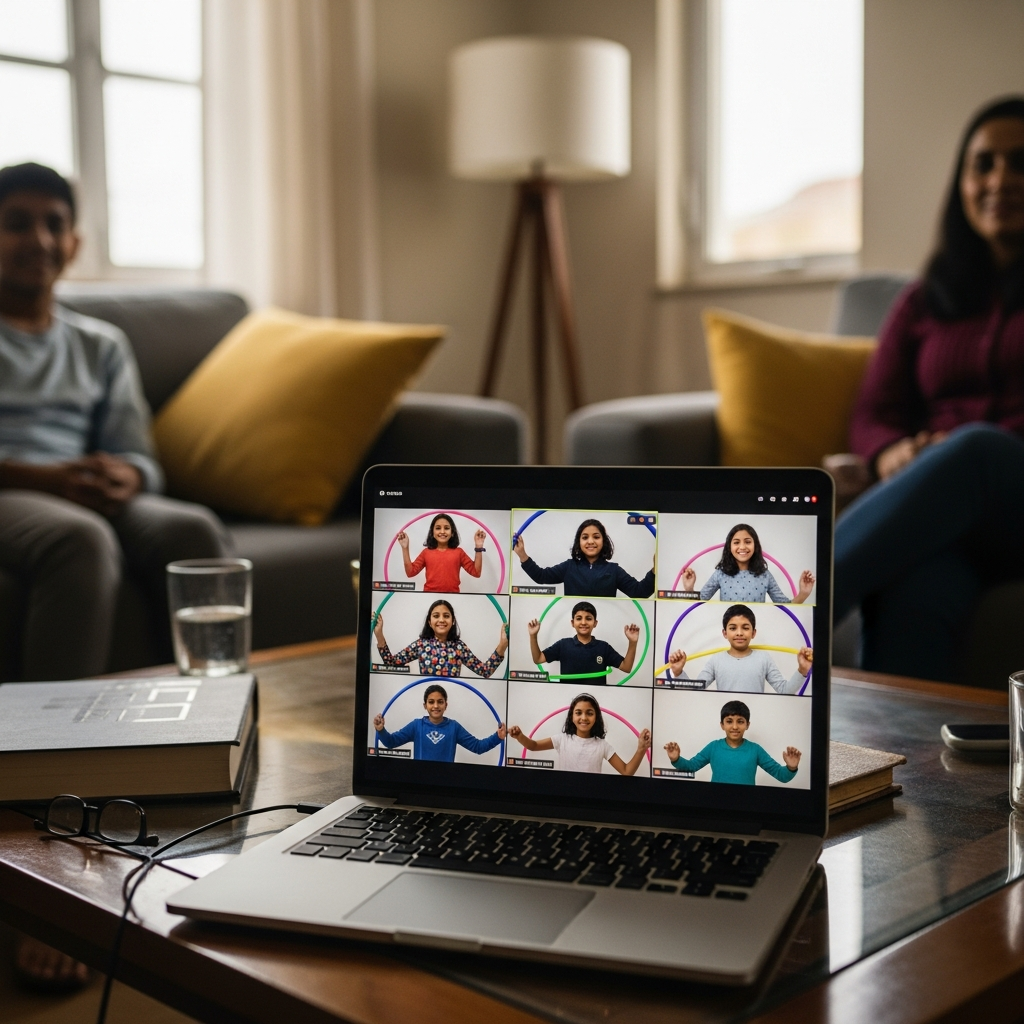
- Advantages: Access from anywhere (village or metro), flexible scheduling, recorded replays, lower cost, no commute, learn from specialist instructors regardless of location
- Challenges: Requires self-motivation, parent may need to help younger kids (4-6) with setup
- Best for: Families who want expert instruction without geographic limitations
The Verdict
For most Indian families, online classes win on accessibility and value. Hula hoop instruction is a niche skill — finding a qualified local instructor is nearly impossible in most cities. Online platforms like HoopStar Academy connect your child with 25+ trained instructors who specialise exclusively in hula hoop education, with structured level progression that most local classes can’t match.
Our students come from across India, the UAE, the USA, and 8+ countries — proof that online learning works beautifully for physical skills when the instruction is structured and engaging.
Real Summer Stories: How HoopStar Students Spend Their Holidays
Don’t just take our word for it. Here’s what summer looks like for HoopStar families:
“My daughter used to spend her entire summer on YouTube. Last year, she enrolled in HoopStar during April and by May she was performing for the whole family. The confidence change was unbelievable.”
— Parent of a Level 3 student, Bangalore
“We’re in Dubai and finding physical activities during summer is tough — it’s too hot to go outside. Online hula hoop classes were perfect. My son practices in the living room every morning.”
— Parent of a Level 2 student, UAE
“What I love about HoopStar is the level system. My child knows exactly what she’s working towards. She finished Level 1 in summer and immediately wanted to start Level 2.”
— Parent of a Level 2 student, Pune
With 500+ students across multiple countries and a structured 6-level curriculum, HoopStar Academy has become India’s leading online hula hoop school — and summer is when most new students discover us.
How to Make This Summer Count: A Parent’s Action Plan
Summer 2026 doesn’t have to be a screen-time battleground. Here’s a simple framework:
Step 1: Set a Physical Activity Goal
Decide that your child will do at least 30 minutes of physical activity daily this summer. Not as punishment — as a non-negotiable, like brushing teeth. Make it the first activity of the day, before screens.
Step 2: Let Your Child Choose the Activity
Kids stick with activities they choose. Present 2-3 options (dance, hula hoop, yoga, sports) and let them pick. Autonomy drives consistency.
Step 3: Start Before Summer Officially Begins
Don’t wait for April. Starting in March gives your child a head start — by the time summer vacation begins, they’ll already have momentum and won’t default to screens out of boredom.
Step 4: Make It Social
Enrol with a cousin or friend. Having a buddy in class makes it more fun and adds accountability. At HoopStar, many of our group batches have kids who know each other — it becomes their shared summer project.
Step 5: Celebrate Progress, Not Perfection
Record a video on Day 1 and another on Day 30. The improvement will speak for itself. Share it with grandparents, post it on the family group — let your child see how far they’ve come.
Frequently Asked Questions
What age can kids start hula hooping?
Children as young as 4 can start learning basic hula hoop skills. At HoopStar Academy, we have separate batches for ages 4-6 and 6-18, with age-appropriate teaching methods for each group.
Do online physical activity classes really work?
Yes — when they’re well-structured. The key is live instruction (not pre-recorded videos), small batch sizes so the instructor can give individual attention, and a clear progression system. HoopStar’s classes have a maximum of 12 students per batch for exactly this reason.
How much does it cost?
HoopStar Academy’s kids’ classes start at ₹2,999 for 12 sessions — that’s about ₹250 per class. Compare that to in-person summer camps at ₹5,000-15,000 per week.
What equipment do we need?
Just a hula hoop (₹200-500 from any sports store or Amazon) and a space about 6 feet wide where your child can stand and extend their arms. No special flooring, no expensive gear.
Can boys do hula hooping too?
Absolutely! About 30% of HoopStar students are boys. Hula hooping is a sport and performing art — it builds strength, coordination, and athletic skills that benefit any physical activity. Some of our most advanced students and performers are boys.
What if my child has never tried hula hooping?
That’s exactly who our Level 1 classes are for. No prior experience needed. Our instructors start from absolute basics — how to hold the hoop, the first push, finding the rhythm. Most beginners can sustain a waist hoop within 2-3 classes.
You Might Also Enjoy
- Fun Hula Hoop Exercises for Kids: Get Active! — Simple exercises to get your child started at home
- From Couch to Confident: How HoopStar Transforms Kids — Real transformation stories from inactive to active
- Fun Activities for 10 Year Olds: Hula Hooping and More! — Age-specific activity ideas for tweens
Start Your Child’s HoopStar Journey This Summer
Join 10,000+ kids across India, UAE & USA learning hula hoop with HoopStar Academy.
Enroll on WhatsAppNo hula hoop class near you? See how kids learn live online, from anywhere →
Summer is just one season — for the year-round view, see our guide to online activities for kids by age and interest.