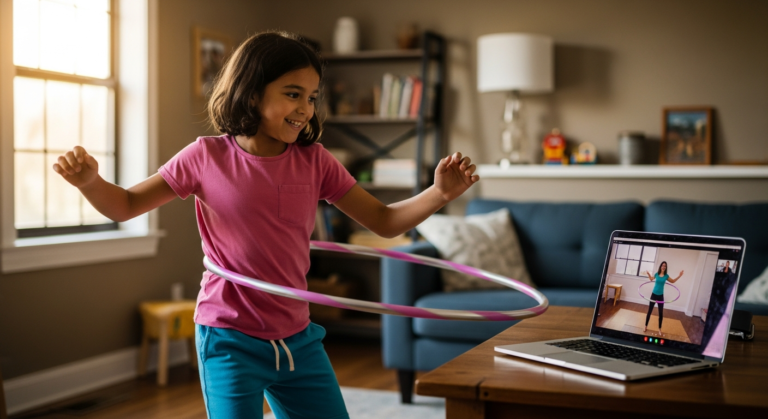
Quick answer: For most children, the right hula hoop size is 24-28 inches for ages 3-5, 28-32 inches for ages 6-9, and 32-36 inches for ages 10-12. The easiest way to remember it: 20 + your child’s age (in years) = the hoop diameter in inches — within each band, younger kids do best at the lower end (exact per-age picks in the chart below). So a 6-year-old wants a roughly 26-inch hoop, and an 8-year-old wants about a 28-inch one. And here’s the part almost no buying guide tells you: when in doubt, size up. A slightly bigger hoop spins slower, which makes it far easier for a beginner to learn on and far less likely they give up in the first week. That advice comes from real experience — across 20,000+ class enrollments from nearly 13,000 families, we’ve watched exactly which hoops keep kids spinning and which ones end up in the cupboard.
Hula Hoop Size Chart by Age (Screenshot This)
Save this table — it’s handy when a birthday, a gift request, or back-to-school shopping suddenly puts “buy a hula hoop” on your list. It’s the whole decision in one place, based on the sizing guidance published by hoop makers like MoodHoops and Hooper Hoops, and matched to what we actually see work with kids in class.
| Child’s age | Recommended diameter | “20 + age” quick pick | What the hoop is really for at this age |
|---|---|---|---|
| 3-4 years | 24-26″ | ~24″ | Play, rolling, stepping in and out – not waist spinning yet |
| 5 years | 25-28″ | ~25″ | First tries at waist hooping; lots of imaginative play |
| 6 years | 26-30″ | ~26″ | Coordination starts clicking; waist hooping becomes learnable |
| 7 years | 27-31″ | ~27″ | Sustained waist spins; ready for first tricks |
| 8-9 years | 28-32″ | ~28-29″ | Confident hooping; hand spins, walking while hooping |
| 10-12 years | 32-36″ | ~30-32″ (treat as the minimum) | Fluent skills; can move toward a lighter, smaller hoop over time |
These are starting points, not hard rules. A tall, sporty five-year-old may be happy on a 27-inch hoop; a petite eight-year-old just beginning may do better on a 30-inch one. When you’re unsure, round up. One note on the formula: past age 10 it starts to undershoot — treat “20 + age” as the beginner’s minimum, and buy within the chart’s range.
The “Best Hula Hoop for Kids” Isn’t a Brand — It’s the Right Size and Weight
Parents often search for the best hula hoop for kids expecting a product name. But after teaching hula hoop across more than 19,000 kids’ enrollments, we can tell you the honest answer: the best hula hoop for a child is simply the one sized to their age and light enough not to hurt. Get those two things right and almost any well-made hoop works; get them wrong and even the most expensive hoop fails. The rest of this guide shows you exactly how to get them right.
The Real Reason Size Decides Whether Your Child Sticks With It
Most sizing guides treat this like buying shoes: get the number that “fits” and you’re done. After coaching thousands of children through their first hula hoop lessons online, here’s what we’ve learned that the charts leave out.
A hoop that’s too small or too heavy spins too fast to learn on. That’s the whole game. Physics is doing something quietly unfair to beginners here: a smaller hoop has to whip around your child’s waist much faster to stay up. Faster spin means less time for a new hooper to react, adjust their hips, and catch the rhythm. The hoop drops in a second, they feel like they “can’t do it,” and by day three they’ve decided hula hooping isn’t for them.
A bigger hoop does the opposite. It rotates slower, hangs in the air longer on each turn, and gives a child those extra beats they need to figure out the motion. Slower is easier. Easier means a small win on day one. And a small win on day one is the single biggest predictor of whether a kid picks the hoop up again on day two.
The mistake we see most: a parent buys a shiny, small, “cool-looking” adult fitness hoop, the child can’t get a single rotation, and everyone concludes the child “isn’t coordinated.” Nine times out of ten it wasn’t the child. It was the hoop spinning faster than any beginner could keep up with. Resize to something bigger and lighter, and the same “uncoordinated” kid usually starts getting the hang of it.
So as you read the age sections below, hold this in mind: you’re not just buying a size that fits. You’re buying the hoop most likely to give your child an early success – the reason they’ll want to keep going.
What over 20,000 Enrollments Tell Us About the Right Age to Start
Hoop makers like The Joy of Hooping and MoodHoops say the coordination for real waist hooping usually arrives around age six or seven. Our own enrollment data — 20,000+ class enrollments across nearly 13,000 families — independently confirms it, in the most honest way possible: by showing when parents and kids actually succeed at starting.
- 36% of our students start at age 6-7 — thousands of them, more than any other age band. Our enrollment curve peaks exactly where the coordination research says waist-hooping ability develops.
- Our average starter is 7 years old.
- 26% start at 4-5 (5,051 kids) — plenty of children begin earlier, mostly in a play-first way.
- 23% start at 8-9 and 11% at 10-12 — it is never “too late”; thousands of kids start comfortably in the later bands.
- Under age 4, starts are essentially zero — just 31 children out of over 20,000 (under 1%). Below four, a hoop is a toy to roll and step through, not a skill to learn — and that’s exactly how it should be.
Why does this matter for a sizing decision? Because it tells you what to expect. If your child is 6 or 7, they’re starting at the peak readiness age — a correctly sized hoop will likely get them spinning fast. If they’re 4 or 5, buy the hoop, but grade your expectations to play. And if they’re 9 or 11, relax: a third of our students start at 8 or later.
What Size Hula Hoop for a 5 Year Old?
Go for roughly 25-28 inches (the “20 + age” rule lands you at 25″). At five, most children are somewhere on the edge of real waist hooping. Some get a spin or two; many are still using the hoop for imaginative play – rolling it, jumping through it, spinning it on the ground.
That’s completely normal. Hooping educators — see MoodHoops and The Joy of Hooping — note the coordination for sustained waist hooping usually arrives closer to age six or seven, and our own numbers agree: 26% of our students start at 4-5, but the big wave (36%) comes at 6-7. So at five, pick a light, forgiving hoop on the larger end of the range, and treat every drop as play, not failure. The goal here is joy and familiarity, not tricks.
What Size Hula Hoop for a 6 Year Old?
Aim for about 26-30 inches. Six is often the sweet spot where things start to click – the hips learn the push-pull motion and the child gets their first real, repeatable spins. This isn’t just theory for us: age 6-7 is when more kids start at HoopStar than any other age — 36% of all our 20,000+ class enrollments — which is about as strong a real-world signal of “readiness” as you can get. This is also the age where the right size matters most, because a six-year-old is right on the line between “I can do this!” and “I give up.”
Size up rather than down. A 28-inch hoop that turns slowly will teach a six-year-old faster than a 24-inch one that blurs past their waist. Once they can hold a spin for 10-15 seconds consistently, they’re hooked – and you can worry about smaller hoops much later.
What Size Hula Hoop for a 7 Year Old?
Around 27-31 inches works well. Seven is our single most typical starting point — the average age of a first-time HoopStar student is exactly 7. By this age, most kids can sustain a waist spin and are itching to try their first tricks – walking while hooping, lifting it from waist to chest, or a simple hand spin. A hoop in this range is big enough to stay learnable but small enough that it won’t feel unwieldy for those early tricks.
If your seven-year-old already hoops confidently, you have room to come down toward 27-28 inches. If they’re just starting, stay at the top of the range.
What Size Hula Hoop for an 8 Year Old?
Choose about 28-32 inches. Eight-year-olds usually have the coordination to hoop comfortably and the patience to practise a trick until it works. This is a great age to introduce a hoop they can “grow with” for a year or two. And if you’re worried they’ve “missed the window” — they haven’t: nearly a quarter of our students (23%) start at 8-9.
Still, don’t be tempted by a heavy hoop just because they’re older. Weight, not just size, is what bruises and discourages kids (more on that below). A light 30-inch hoop beats a heavy 28-inch one every time for an eight-year-old learner.
What Size Hula Hoop for a 10 Year Old?
Go with roughly 32-34 inches for a beginner. Here the “20 + age” formula (~30″) starts to undershoot — treat it as the bare minimum, and buy from the chart’s 32-36″ band instead. Ten-year-olds are strong and coordinated enough for near-adult sizes, and about 11% of our students start in the 10-12 window, so it’s a well-trodden path.
But “can” doesn’t mean “should on day one.” If your ten-year-old is brand new to hooping, start at 32-34 inches and let them earn their way down to a smaller, quicker hoop as their control improves. If they’re already skilled, the smaller end of that range gives them room to learn faster tricks; taller or older kids can go up to 36 inches.
Beyond Size: Weight and Material Matter Just as Much
You can get the diameter perfect and still buy a hoop that quietly sabotages your child. Here’s what else to check.
- Lighter is better for kids. Hooper Hoops and most kids-hoop specialists agree: children learn best on light hoops. A heavy adult “fitness” or “weighted” hoop can leave real bruises on a small torso, and nothing ends a hobby faster than it hurting.
- Skip weighted and “smart” hoops for beginners. Those weighted hoops with a ball on a track are made for adult ab workouts, not for kids learning the classic waist spin. They teach a different motion and can be too heavy.
- A little grip helps. Hoops with a slightly textured surface or gentle ridging grip the body a touch more, spin a hair slower, and are more forgiving for beginners.
- Collapsible hoops are convenient for storage and travel, just make sure the connectors are smooth so they don’t pinch.
Put simply: for a child, bigger and lighter is almost always the beginner-friendly choice. Small and heavy is where beginners lose heart.
Is It Even Good for Them? The Benefits, Briefly
Beyond the fun, hula hooping is a genuinely good movement activity for growing kids. Dr. Meghashri Shende (BAMS) — a doctor and herself a HoopStar parent — covers this in depth in her review of the benefits of hula hooping for kids: it builds core strength, balance and body awareness, and the steady, rhythmic focus it demands can be especially settling for restless, high-energy kids who struggle to sit still.
That lines up with what pediatric-development resources such as North Shore Pediatric Therapy (NSPT) note about hooping and similar rhythmic activities: they support coordination, attention, and the confidence that comes from mastering a physical skill. And from our own coaching, the confidence piece is real – the day a child holds their first long spin, you can see it change how they carry themselves.
Frequently Asked Questions
What size hula hoop should I get for a 5 year old?
About 25-28 inches. At five, keep it light and on the larger side; most children this age are still developing the coordination for steady waist hooping, so treat it as playful practice rather than expecting tricks.
What size hula hoop is best for a 6 year old?
Roughly 26-30 inches. Six is often when waist hooping starts to click — across our 20,000+ class enrollments, age 6-7 is the most common starting age (36% of students) — so this is the age where sizing up (for a slower, more learnable spin) pays off the most.
What size hula hoop for a 7 year old?
Around 27-31 inches. Most seven-year-olds can sustain a spin and try early tricks; stay at the top of the range if your child is a beginner, and come down slightly if they’re already confident. Seven is the average starting age across our 19,000+ enrollments.
What size hula hoop for an 8 year old?
About 28-32 inches. Eight-year-olds can handle a hoop they’ll grow with, but prioritise a light hoop over a heavy one – weight, not just size, is what discourages kids.
What size hula hoop for a 10 year old?
Roughly 32-34 inches for a beginner (the 20 + age formula gives ~30″, but treat that as the minimum at this age). Ten-year-olds can approach adult sizes; start larger and let them move to smaller, faster hoops as their control improves.
Is a bigger or smaller hula hoop easier for a child to use?
Bigger is easier for beginners. A larger hoop spins more slowly, giving a child extra time to react and catch the rhythm on each rotation. Smaller hoops spin faster and are much harder to learn on, which is why so many kids give up on a hoop that’s too small.
What age can a child start hula hooping?
Toddlers can play with a hoop (rolling it, stepping through it) from about age three, but the coordination for real waist hooping usually develops around age six or seven. Our own data backs this up: across 20,000+ class enrollments, 6-7 is the most common starting age, while starts under age 4 are almost zero (under 1%). Every child is different, so let interest and success guide you rather than the calendar.
Are weighted hula hoops safe for kids?
Generally, no – weighted and “smart” fitness hoops are designed for adult workouts and can bruise a child or teach the wrong motion. For kids, choose a light hoop sized to their age.
See How We Teach It
Sizing is step one. The bigger unlock is how a child is taught those first spins – the small cues that turn a week of frustration into a week of wins. At HoopStar Academy, our coaches have taught hula hoop across more than 19,000 kids’ enrollments in live online classes, and getting beginners to their first success quickly is exactly what we’re built around.
Curious what that looks like? Message us on WhatsApp and we’ll show you how our coaches teach the first spins, and help you figure out the right hoop for your child’s age and level – no pressure, just a straight answer.
Written by the HoopStar Academy coaching team. For a doctor’s (and HoopStar parent’s) perspective on the health side, read Dr. Shende’s guide to the benefits of hula hooping for kids, or explore live online hula hoop classes at HoopStar Academy. Enrollment figures cited are from HoopStar Academy’s own class records (20,000+ class enrollments, verified July 2026).