 5 min
5 min
Complete Guide to Hula Hoop Classes for Kids (2026)
 Pooja Agrawal
Author: Pooja Agrawal, Founder & Head Teacher, HoopStar Academy
Updated: June 2026
Reading time: ~12 minutes
Bio: Pooja Agrawal is the founder of HoopStar Academy and a certified hula hoop instructor with over 8 years of experience teaching children aged 4–18. She has trained 15,000+ students across India, UAE, and 20+ countries. Passionate about structured play and child development, Pooja designed HoopStar’s 6-level curriculum to give every child a clear path from first spin to performance stage.
Introduction
Every parent has seen it: a child picks up a hula hoop, gives it one enthusiastic spin — and it drops. They laugh, try again, and before you know it, an hour has passed.
That moment of discovery is exactly where hula hoop classes begin.
But structured hula hoop training is far more than a fun activity. It’s a full-body developmental experience that builds coordination, core strength, confidence, and focus — skills children carry with them long after they’ve outgrown the hoop.
This guide covers everything a parent needs to know about hula hoop classes for kids in 2026: the benefits by age group, what to expect in a real class, safety guidelines, how to choose the right program, and why thousands of families across India and the world have made hula hoop training a core part of their child’s routine.
What Are Hula Hoop Classes for Kids?
Hula hoop classes are structured fitness and movement sessions where children learn to spin, control, and perform tricks with a hula hoop under the guidance of a trained instructor.
Unlike PE class or backyard play, a proper hula hoop program follows a progressive curriculum — from basic waist hooping to body rolls, arm isolations, and full choreography. Each skill builds on the last, giving children a sense of measurable achievement and a reason to show up every week.
At HoopStar Academy, classes follow a 6-level progression system (L1 through L6) designed for children aged 4 to 18, with each level introducing new skills, increasing difficulty, and rewarding mastery with a clear advancement milestone.
Benefits of Hula Hoop Classes for Kids
Physical Development
Core strength and posture
Hula hooping is one of the most effective core workouts for children. Keeping the hoop spinning engages the abdominals, obliques, and lower back — muscles that support posture and prevent back issues in later years. Kids who hula hoop regularly develop noticeably better posture and body awareness.
Cardiovascular fitness
A 30-minute hula hoop session qualifies as moderate aerobic activity — exactly what the WHO recommends (60 minutes/day for children 5–17). Unlike running on a treadmill, hooping doesn’t feel like exercise. Children get their heart rates up without realizing it.
Coordination and motor skills
Hula hooping requires the brain and body to work in sync. Timing, rhythm, spatial awareness, and bilateral coordination all improve with practice. Children who struggle with gross motor skills often find significant improvement after consistent hula hoop training.
Balance and flexibility
Tricks like leg hooping, vertical spinning, and body rolls develop balance and hip flexibility. These skills transfer directly to dance, gymnastics, football, and everyday activities.
Cognitive and Emotional Development
Focus and concentration
Learning a new hula hoop trick requires sustained attention. When a child spends 10 minutes figuring out how to keep the hoop up while walking, they’re building the same mental muscles needed for academic focus. Many parents report improvements in school attention after consistent hula hoop classes.
Confidence and self-esteem
Every new trick mastered is a win. The hula hoop is uniquely democratic — a quiet, introverted child who can’t make it through a football game can become the star of a hula hoop performance. Skill mastery creates visible pride and the courage to try harder challenges.
Stress relief and emotional regulation
The rhythmic, repetitive motion of hooping has a calming effect. Children use it instinctively — when they’re frustrated, they pick up the hoop. Structured classes give children a positive outlet for restless energy and anxiety.
Social skills and teamwork
Group classes build friendships and communication. Partner tricks and group choreography require children to coordinate with peers, listen to feedback, and celebrate each other’s achievements.
Benefits by Age Group
Ages 4–6: Discovery and Play
At this age, children are building foundational motor skills. A hula hoop becomes an exploration tool — spinning it on the floor, jumping through it, trying (and failing) to keep it on their waist with big belly laughs.
What they develop:
- Gross motor coordination (large body movements)
- Body awareness and spatial understanding
- Attention span through structured short activities
- Social confidence in a group setting
What to expect in class:
Short activity bursts (5–7 minutes each), lots of playful challenges, no pressure to hold the hoop at the waist. Teachers focus on engagement and exploration. The “win” at this age is showing up and having fun.
Parent tip: Don’t rush advancement. A 4-year-old who loves class and asks to practice at home is succeeding perfectly.
Ages 6–12: Skill Building and Achievement
This is the golden age for hula hoop learning. Children in this range have the motor coordination to begin mastering waist hooping and the cognitive ability to understand technique feedback. Progress is fast and visible.
What they develop:
- Core waist hooping and isolation techniques
- Multi-tasking (hooping + footwork, hooping + arm movements)
- Goal-setting through level progressions
- Resilience — learning that dropping the hoop is part of the process
What to expect in class:
Progressive skill building from L1 basics to L2–L3 tricks. Classes include individual practice, group choreography, and milestone assessments. Children can advance through levels, which provides a game-like progression structure.
Key milestone: A 7-year-old can typically reach confident waist hooping within 4–8 classes. A 10-year-old can learn body rolls, walking hoops, and basic arm catches within 3–4 months.
Ages 12–18: Performance and Expression
Teenagers bring a different energy to hula hoop training. They’re capable of complex, rapid skill acquisition and drawn to self-expression. At this age, hooping becomes an art form — combining fitness with creative performance.
What they develop:
- Advanced techniques (vertical hooping, multi-hoop, isolations)
- Choreography and stage presence
- Physical confidence and body positivity
- Self-expression through movement
What to expect in class:
L3–L6 level content, individual and group choreography, performance opportunities. Teenagers who engage deeply often reach performance-ready skill levels within 12–18 months.
Important note for parents: Hula hoop training is particularly effective for teens who feel out of place in traditional sports. It’s non-competitive, creative, and rewards persistence — ideal for introverted or artistic teenagers.
How to Start: A Parent’s Step-by-Step Guide
Step 1: Choose the Right Class Format
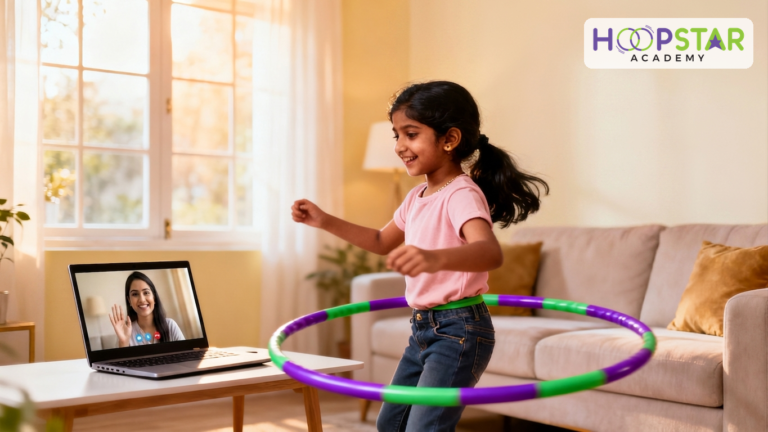
Online classes offer flexibility, consistent instructors, and the ability to learn at a comfortable pace from home. HoopStar Academy’s online classes are live and interactive — not pre-recorded videos — with real-time feedback from certified instructors.
In-person classes provide social interaction and physical hands-on correction. Best for younger children who need tactile guidance.
For children under 6, in-person classes are often easier to manage. For ages 7+, online live classes work extremely well and remove the travel barrier.
Step 2: Get the Right Hoop
Hoop size matters enormously for beginners:
- Ages 4–6: 60–70 cm diameter, lightweight polypropylene
- Ages 6–12: 70–80 cm diameter, standard weight
- Ages 12+: 80–90 cm, standard or slightly weighted
Rule of thumb: When standing upright, the hoop should reach between the child’s waist and chest. A hoop that’s too small makes learning nearly impossible and leads to frustration.
Common mistake: Parents buy 24-inch (60 cm) hoops for beginners. The 36-inch (90 cm) version is far easier for beginners — the larger hoop moves slower, giving the child more time to react.
Step 3: What to Wear
- Fitted clothes that don’t bunch around the waist (avoid loose shirts or belts)
- Leggings or fitted athletic pants (not jeans)
- Bare feet or non-slip socks
- No jewelry, especially necklaces or bracelets
Step 4: Create Practice Space at Home
A 2m × 2m clear space is all that’s needed. Remove fragile items from the area. Kids practice best when they have a dedicated spot — even marking it with tape on the floor creates a “hooping zone” they’ll use independently.
Step 5: Support Without Pressure
The biggest predictor of success is a parent who celebrates effort, not just results. Say “that was amazing persistence” more than “did you get it yet?” The hoop drops a lot at first. That’s not failure — that’s learning.
Safety: What Every Parent Should Know
Hula hoop classes are among the safest physical activities for children. There is no equipment collision, no contact sport risk, and no weight-bearing joint stress. However, a few guidelines ensure safety:
Hoop quality: Use child-appropriate hoops made from polypropylene. Avoid metal hoops or adult-weighted hoops for children under 10.
Space safety: Ensure the practice area is free from sharp furniture edges, breakable objects, or ceiling fixtures.
Warm-up and cool-down: Quality classes always begin with a 5-minute warm-up (gentle stretching and movement) and end with a cool-down. Never let children start vigorous hooping cold.
Posture awareness: Beginners often tense their shoulders. Good instructors regularly cue relaxation of the upper body to prevent shoulder strain.
Back awareness: For children with existing back concerns, inform the instructor before class. Waist hooping is generally safe, but adjustments can be made.
Frequency: 2–3 sessions per week is optimal for skill retention and physical benefit without overuse. Daily practice of 20–30 minutes is a positive sign of engagement.
What to Expect in a HoopStar Academy Class
Every HoopStar class follows a structured format:
1. Warm-up (5 minutes)
Light movement, gentle stretches targeting core and hips, and a quick review of the previous class’s skills.
2. Skill Block 1 (10 minutes)
Instructor introduces or refines one core technique. Students practice with real-time feedback.
3. Skill Block 2 (10 minutes)
A new trick building on Skill Block 1, or a partner/group activity.
4. Choreography Practice (8 minutes)
Students work on a short routine combining multiple skills — culminates in a mini-performance at the end of each level.
5. Cool-down and Recap (5 minutes)
Stretching, instructor feedback, and a preview of what’s coming next class.
Class size: Maximum 8–10 students per batch to ensure individual attention.
Instructor certification: All HoopStar instructors complete a 40-hour certification covering child development, hoop technique, and classroom management.
HoopStar Data Snapshot
Since launching in 2020, HoopStar Academy has served:
- 15,000+ students trained globally
- Students in 20+ countries, including India, UAE, USA, UK, Singapore, and Australia
- Age groups: 4–6, 6–12, 12–18, 18+ (adult fitness)
- Progression stats: Students who complete L1 have an 82% re-enrollment rate in L2
- 6 progressive levels from L1 (Beginner) to L6 (Master Performance)
- Online format: 100% live and interactive — no pre-recorded videos
- Certified instructors: All teachers trained under HoopStar’s proprietary certification program
Student Testimonials
Riya, age 9, Mumbai
Before joining HoopStar, Riya had never been able to keep the hoop up for more than 3 seconds. Eight weeks into L1 classes, she performed a 2-minute routine at her school’s annual day. Her posture has improved dramatically and she practices every single day without being asked.
— Priya M., Riya’s mother
Arjun, age 12, Bangalore
Arjun plays cricket but struggled with coordination at fielding. His cricket coach actually pointed out the improvement after 3 months of HoopStar classes — better footwork, quicker reaction time. He’s now in L2 and can do a 90-second choreography routine. We didn’t expect the cross-sport benefits.
— Suresh K., Arjun’s father
Zara, age 7, Dubai
Zara is very shy and had anxiety about group activities. HoopStar’s small batch sizes made all the difference — the teacher knew her name from Day 1. Six months in, she’s asking to perform for family. We’ve seen her confidence explode in all areas of life.
— Faiza A., Zara’s mother
Aarav, age 15, Pune
I started because my younger sister was doing it and I was bored. By L2 I was genuinely hooked. The feeling when you nail a trick you’ve been working on for a week is addictive. I practice 45 minutes a day now. My PE teacher says my core is stronger than anyone in my class.
— Aarav, student
Meera, age 6, Chennai
Meera has sensory processing challenges. Her occupational therapist actually recommended hula hoop activities for proprioceptive input. HoopStar’s L1 class was perfectly paced — short activities, lots of encouragement, no pressure. Three months in, she can waist hoop for 30 seconds and she’s so proud of herself.
— Lakshmi R., Meera’s mother
Frequently Asked Questions
Q: At what age can a child start hula hoop classes?
A: Children as young as 4 can begin structured hula hoop classes. At this age, the focus is on play-based exploration rather than technical skill. Most formal level-based curricula begin at age 5–6. There is no upper age limit — adults in their 60s participate in HoopStar’s fitness programs.
Q: My child has never been able to keep the hoop up. Is that normal?
A: Completely normal. The technique for keeping a hoop at the waist is counterintuitive — most first-timers rotate their hips in circles, when the correct motion is a front-to-back rocking. A trained instructor fixes this within the first 1–2 classes. Almost every child who says “I’m terrible at hula hooping” becomes competent within 4–6 sessions with proper instruction.
Q: How is a hula hoop class different from just buying a hoop and letting my child play?
A: Independent play develops enthusiasm but rarely develops skill. A trained instructor provides:
- Correct technique from the start (bad habits are hard to unlearn)
- Progressive challenges that maintain engagement and prevent plateaus
- Structured curriculum with clear advancement milestones
- Group dynamics that motivate practice
- Safety guidance and proper hoop sizing
Q: How many classes per week are recommended?
A: Two live classes per week plus 20–30 minutes of home practice 3–4 days per week is the optimal learning schedule. One class per week is better than none but slows progress significantly. Children who practice daily see the fastest results.
Q: Can hula hoop classes help children with ADHD or sensory processing issues?
A: Many families report positive effects. The rhythmic, repetitive motion of hooping has a regulating effect on the nervous system. The activity provides clear, measurable goals (can you keep it up for 30 seconds?), which suits children who need concrete progress markers. Small batch classes with consistent instructors also reduce sensory overwhelm. We recommend speaking with your child’s therapist before enrolling if there are significant sensory or behavioral concerns.
Q: How long does it take to see progress?
A: Most children achieve consistent waist hooping within 4–8 classes. By the end of L1 (typically 12 sessions), children can perform a short routine combining 3–4 skills. The timeline varies based on age, natural coordination, and how much they practice at home — but virtually every child makes visible progress within the first month.
Q: Are online hula hoop classes effective for kids?
A: Yes, with two conditions: the class must be live and interactive (not a pre-recorded video), and the child needs an appropriate practice space at home. HoopStar’s 15,000+ students are overwhelmingly from online batches. The advantages of online — consistent instructor, flexible scheduling, no travel time — often outweigh in-person benefits for children 6 and older.
Q: What is the difference between HoopStar’s L1 through L6 levels?
- L1 (Beginner): Waist hooping, basic rhythm, first tricks, confidence building
- L2 (Explorer): Isolation techniques, walking with hoop, basic arm catches
- L3 (Intermediate): Body rolls, vertical moves, multi-skill sequences
- L4 (Advanced): Performance choreography, complex transitions, stage presence
- L5 (Pro): Competition-ready skills, artistic expression, original choreography
- L6 (Master): Master-level performance, mentorship eligibility, world-record eligible techniques
Q: How do I enroll my child?
Visit hoopstar.academy to see current batch schedules, pricing, and available slots. Demo classes are available for first-time students. WhatsApp enquiries: +91 7499039289.
Internal Links
- HoopStar Academy Levels: L1 Through L6 Explained
- Hula Hoop for Kids: Fun and Effective Exercise
- Book a Demo Class
- HoopStar for Adults
Conclusion
Hula hoop classes are one of the most complete physical activities available to children. They build strength, coordination, cardiovascular fitness, confidence, and creative expression — all while feeling like play.
The difference between a child who drops the hoop after 3 seconds and one who performs a 3-minute routine is not natural talent. It’s structured instruction, progressive challenges, and a teacher who knows how to keep children engaged.
If you’ve been wondering whether hula hoop classes are worth it for your child — the answer, for most families, is yes. The investment in equipment is minimal (one appropriately sized hoop), the time commitment is manageable (2–3 sessions per week), and the developmental returns extend far beyond the hoop itself.
HoopStar Academy offers free demo classes for first-time students. There’s no commitment and no pressure. The hoop does the rest.
HoopStar Academy — Structured Hula Hoop Classes for Children Aged 4–18
Live online classes | Certified instructors | 6-level curriculum | 15,000+ students globally
Sources used in research:
- North Shore Pediatric Therapy: Hula Hooping Benefits
- ACFS Community Education: Developmental Benefits of Hula Hooping
- MoodHoops: How to Hula Hoop for Beginners
- HoopStar Academy: Levels Overview
- Ruby Hooping: Beginner’s Guide
- WHO Physical Activity Guidelines for Children
Real student success stories from around the world
HoopStar kids don’t just learn to hoop — they perform, compete and grow in confidence, from India to Malaysia to Nepal. A few favourites:
- From first spin to the school talent stage — a HoopStar student in Malaysia
- From Kathmandu to confident hoopers (Nepal)
- Vedanshi’s hula-hooping journey (India)
- Sreetanwi’s hula hoop journey
- How 7-year-old Moukthika built confidence through hula hooping
No class near you? See how kids learn from home in live online hula hoop classes, from anywhere.
Hula hooping is one of several online activities for kids we teach — see how it fits alongside drawing and dance.
Want the full picture? Explore our complete hula hoop curriculum for kids — all 78 skills, Level 1 to 7, with videos.