Online Activities for Kids: The Complete Guide by Age (2026)
 Pooja Agrawal
Online activities for kids have quietly become the easiest way to give your child something real to do that isn’t a screen watching a screen. But “put them in an online class” and “put them in front of YouTube” are opposite things — and as a parent, the gap between the two is exactly what you’re trying to navigate. This guide from HoopStar Academy lays out the online extracurricular options for kids ages 4–14, broken down by age and by interest, so you can match your child to the right one in a few minutes.
The real question isn’t “online or not” — it’s “active or passive”
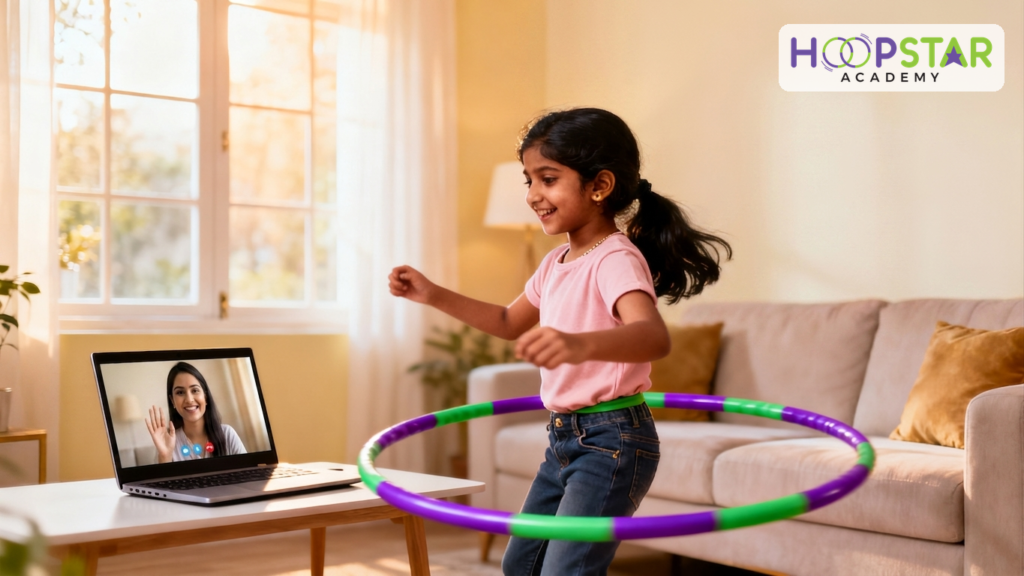
Most screen time is passive: the child sits still while the screen moves. A live online activity class flips that — the child moves, the screen stays put. Same device, opposite outcome. That single distinction is what turns “more screen time” into a kid who’s up on their feet, coordinated, and proud of something they built week over week.
That’s the whole reason we teach live, in small groups, with a real teacher on the other end — not pre-recorded videos. A recording can’t see your daughter drop the hoop and say “try it with your hips this time.”
“But do online classes actually work for young kids?”
It’s the first thing every parent asks — usually right after “won’t she just get distracted?” Here’s the honest answer: online works when the class is live, small, and physical, and it doesn’t when it’s a passive video library. The advantage online has over a local class isn’t price — it’s flexibility. No commute, no fixed studio slot, a class that fits around school and travel, and a teacher your child can keep even if you move cities or countries. For a lot of families, that convenience is the difference between a hobby that sticks and one that dies in the logistics.
Online activities for kids, by age
Attention span, coordination, and what a child finds “fun” change fast between 4 and 14. Here’s how the common online activities map to age — a starting point, not a rule.
| Age | What works online | What they’re building |
|---|---|---|
| 4–6 | Movement play, hula hooping basics, simple drawing | Gross motor skills, following instructions, first taste of “I can do it” |
| 7–9 | Hula hoop tricks, drawing & art, beginner dance | Coordination, focus, sticking with something past the hard part |
| 10–12 | Hoop routines, art projects, choreographed dance | Confidence, self-expression, a skill they can show off |
| 13–14 | Performance-level hooping, advanced art, dance | Mastery, stage presence, something that’s genuinely theirs |
Want the age-specific version? We’ve written a full guide to fun activities for 10-year-olds, and our complete guide to hula hoop classes for kids covers every level from first-timer to performer.
Online activities for kids, by interest
Motivation follows interest. Start with what already lights your child up — the skill-building takes care of itself once they actually want to show up.
- The mover (can’t sit still, needs to burn energy): live online hula hoop classes — six levels, ages 4–14, built so a fidgety kid ends the class tired and grinning.
- The maker (draws on everything, loves colour): live online drawing & art classes, taught by real art teachers, ages 5–14.
- The performer (dances around the living room, loves an audience): online dance & choreography, where the living room becomes the stage.
What 3,000+ kids taught us about what actually sticks
Across 3,000+ students in 15+ countries, one pattern shows up again and again: kids don’t quit activities because they’re bad at them — they quit when nobody notices they’re getting better. The activities that stick are the ones with a visible ladder: a next level to reach, a routine to nail, a certificate or a little show at the end. That’s why every HoopStar path is built as levels, not as an endless flat stream of classes — so your child always has a “what’s next” pulling them forward.
Activities for any day — including the indoor ones
The best thing about an online activity is that the weather never cancels it. Peak summer heat, monsoon downpour, a cold week when nobody wants to leave the house — the class still happens, and the energy still gets burned indoors. If you’re staring down a long indoor stretch, start here:
- Monsoon & rainy-day indoor activities for kids
- Summer activities for kids and how to keep kids busy over the summer
- Beyond screen time: after-school wellness for kids
How to choose the right one
Once you’ve narrowed it by age and interest, the last step is choosing a specific program. We’ve written a short, honest checklist for that: how to choose the best online extracurricular program for your child. The short version — follow their passion, check that it’s live and small-group, and make sure there’s a clear path to progress.
Try one before you commit
You don’t have to guess whether it’ll click. Book a free live demo class and watch your child on the call — if they’re not up and moving and grinning by the end, it’s not the right fit, and you’ve lost nothing but half an hour.
— Pooja, founder, HoopStar Academy
See all class levels & book a free demo →
Common questions from parents
What age can kids start online activity classes? As young as 4 for movement and hula hoop basics; 5+ for drawing. The class style changes with age — younger kids do shorter, play-based sessions.
Do online classes work if my child gets distracted easily? A live, small-group class with a real teacher is built for exactly that child — it’s active, not a passive video, so there’s nothing to zone out into.
Which activity is best for my child? Start with interest, not “what’s best.” A mover thrives in hula hoop or dance; a maker in drawing. Try a free demo in one and read the room.