Screen Time That Actually Moves: The Hula Hooping Solution
 Amit Agrawal
If you’re a parent, you probably know the feeling. That weekly notification pops up showing your family’s screen time has increased—again. And if you’re like most parents, you feel a mix of guilt, frustration, and helplessness about what to do next.
Hula hooping is one screen-time swap — see all the online activities for kids that get them moving.
Here’s what we know: Common Sense Media reported a 17% rise in daily entertainment screen media use among 8–18-year-olds from 2019 to 2021 (excluding schoolwork)—growing faster than it had over the four years before COVID began. In India specifically, research shows concerning trends. A study of secondary school children in rural Pune found 83.2% exceeded the commonly used “more than 2 hours per day” recreational screen-time threshold. In one rural Western India sample (2019), over 80% of preschool children exceeded advised limits.
But here’s what might surprise you: The problem isn’t screen time itself—it’s what happens during that screen time.
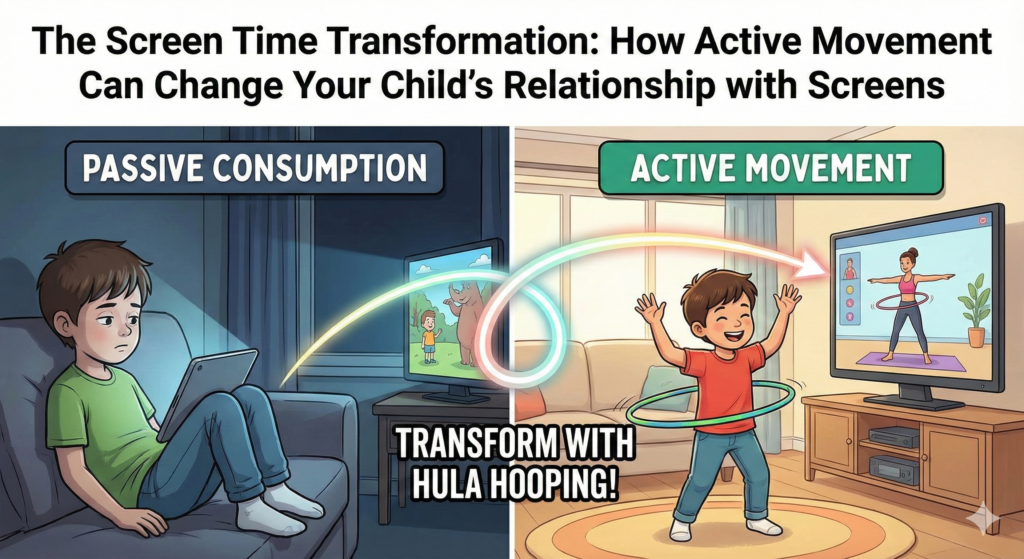
The Critical Difference: Passive vs. Active Screen Use
Not every minute on a screen affects your child the same way. Understanding this difference changes everything.
Passive screen time looks like:
- Scrolling through short videos for hours
- Binge-watching shows on autoplay
- Consuming content without thinking or moving
- Zero physical engagement or mental challenge
Active screen time involves:
- Interactive learning that requires thinking
- Movement-based activities using the screen as a guide
- Creating something rather than just consuming
- Building genuine skills through digital instruction
Studies on active versus passive screen use show different developmental impacts, though the research is still evolving and effects can depend heavily on content, context, and the individual child. What we do know is that when screen time involves physical movement, cognitive engagement, and skill-building, the outcomes may look different from passive consumption.
Why Traditional “Screen Time Battles” Don’t Work
Many parents have tried to simply reduce screen time. How’s that working? For most families, it creates:
- Daily conflicts and power struggles
- Kids who sneak extra screen time
- Parents who feel like the “bad guy”
- No real change in overall behavior
The reality? In 2025, screens aren’t going anywhere. Children need digital literacy. Many schools use tablets for learning. Social connections happen online. Fighting against screens entirely is fighting against how our world actually works.
A Different Approach: Transforming Screen Time from Within
What if instead of fighting screen time, you could transform what happens during those minutes?
This is where online fitness classes—specifically hula hooping—offer something genuinely different. When your child logs on for a hula hoop class, they’re using a screen, but they’re:
- Getting genuine cardiovascular exercise
- Building coordination and core strength
- Learning progressive skills over time
- Creating rather than consuming
- Accomplishing something visible and real
Why Hula Hooping Works When Other Solutions Don’t
1. Kids Actually Want to Do It
Unlike being told to “go outside and play” or join a traditional sport, many kids genuinely enjoy hula hooping. It’s individual (no team pressure), creative (not competitive), and has a modern feel that appeals to children who’ve grown up with screens.
2. It’s Real Exercise—With Real Benefits
Research on adult hula hoopers shows it can be a vigorous activity, with one ACE-sponsored study finding elevated heart rates and significant calorie burn. While the exact intensity varies by age, weight, technique, and hoop type, hula hooping engages the core, improves coordination, and raises heart rate—making it genuine moderate-to-vigorous movement for many people.
Physical benefits often include:
- Cardiovascular conditioning
- Core strength development
- Improved balance and coordination
- Better posture and body awareness
- Enhanced motor skills
3. It Fits Real Family Life
Online classes mean:
- No commuting to studios or classes
- Structured guidance with room for beginners to progress gradually
- Access regardless of weather or location
For busy families, this convenience makes consistency actually possible.
4. It Changes the Parent-Child Dynamic
For many families, the conflict around screens can become as stressful as the screens themselves—raising tension and eroding connection. Research suggests that parents’ stress and guilt around children’s screen use can be strongly linked to how difficult screen time management feels in daily life. When you find screen time that genuinely benefits your child, this often reduces the frequency and intensity of those battles.
You stop being the enforcer of arbitrary time limits and become the supporter of a healthy habit.
What You Can Realistically Expect
Let’s be honest about what hula hooping classes can and cannot do:
What Often Happens:
- Many kids stay engaged for full 45-60 minute classes
- Most children show visible progress within 2-3 weeks
- Some kids practice outside of class time because they enjoy it
- Parents often notice improved mood after movement sessions
- Overall screen time patterns may shift slightly as active time becomes more satisfying
What Won’t Magically Happen:
- Your child won’t suddenly stop wanting passive screen time
- Screen time conflicts won’t completely disappear overnight
- Every child responds differently to any activity
- Building new habits takes time and consistency
The goal isn’t perfection. It’s creating a better balance where at least some screen time involves genuine movement, learning, and growth.
The Bigger Picture: Teaching Digital Citizenship
By introducing active screen experiences, you’re teaching something invaluable: Screens are tools, and we choose how we use them.
This lesson extends far beyond childhood:
- Teens who learn active digital habits are better equipped for healthy technology relationships
- Children who experience productive screen use develop stronger self-regulation
- Families who find positive screen activities together build better connections
Getting Started: A Practical Approach
If this approach resonates with you, here’s how to begin:
1. Start Small Don’t try to overhaul everything at once. Begin with one or two classes per week. See how your child responds. Build from there.
2. Involve Your Child Show them videos of hula hooping. Explain what makes it different. Let them choose their hoop color. When kids feel ownership, they’re more likely to commit.
3. Be Patient with the Process The first few classes might feel awkward. Your child needs time to find their rhythm (literally). Most kids need 2-4 sessions before they start to get comfortable.
4. Celebrate Progress, Not Perfection Notice when your child masters a new move. Take videos comparing week one to week four. Progress is motivating—perfection is impossible.
5. Adjust Your Expectations This won’t solve every screen time challenge. But it might solve some. And sometimes, some is enough.
The Reality Check: What This Actually Solves
Here’s what we’re really talking about:
Before: All screen time feels the same—consumption without benefit, guilt without solutions, conflicts without resolution.
After: Some screen time actively builds your child’s physical fitness, coordination, and skills. That’s not everything, but it’s something real.
The transformation isn’t about eliminating screens. It’s about expanding what screens can do in your child’s life—from purely consumptive to at least partially constructive.
Context Matters: Understanding Your Family’s Baseline
Screen time statistics vary widely by age, location, and circumstances. In India, research shows young children under five spend an average of 2.22 hours daily on screens. Older children and teens can spend several hours a day on entertainment screens—often far above recommended limits.
Every family’s situation is different. What matters isn’t hitting some ideal number but finding a pattern that supports your child’s overall wellbeing—including physical activity, sleep, social connection, and yes, some screen time too.
Moving Forward: Small Changes, Real Impact
You don’t need to revolutionize your family’s entire approach to technology. You just need one or two changes that actually work.
For some families, that’s online hula hooping classes. For others, it might be different active screen experiences. The key is finding something that:
- Your child genuinely enjoys
- Provides real physical or cognitive benefits
- Fits your family’s actual schedule and lifestyle
- Feels sustainable long-term
The research on screen time continues to evolve, and the “perfect” approach doesn’t exist. What does exist? Options that are better than purely passive consumption. Activities that get kids moving while still meeting them in the digital world they already inhabit.
That’s not everything, but it’s something. And sometimes, something is exactly what families need.
Your Next Step
If you’re tired of screen time battles that go nowhere and guilt that solves nothing, consider this: What if you stopped fighting screen time and started transforming it instead?
Online hula hooping classes represent one way to make screens work for your family instead of against it. Not perfectly. Not magically. But tangibly, practically, and realistically.
The transformation doesn’t require eliminating something your kids love. It just requires adding something better alongside it.
Important Note: This article discusses general trends and approaches to screen time management. Every child and family is different. What works for one might not work for another. The goal isn’t to prescribe a single solution but to explore possibilities for healthier screen time patterns that include physical movement and active learning.
Sources: This article references published research including:
- Common Sense Media’s 2021 report on entertainment screen media trends among 8-18 year olds during the pandemic
- Research on screen time patterns in rural Pune secondary school children (Nagargoje VP et al., published in National Journal of Community Medicine)
- Rural Western India preschool screen time study (Pujara J et al., 2019)
- Meta-analysis of screen time in Indian children under five (Kulsoom U et al., published in BMC Public Health)
- Research on active versus passive screen use and parental stress around screen time management
Screen time recommendations vary by organization, and parents should consult current guidelines from their pediatrician or relevant health authorities.