 4 min
4 min
Hiyana’s Hula Hoop Journey: A Hoopstar Academy Success Story
 Pooja Agrawal
Hiyana was four years old when she first picked up a hula hoop — and within minutes, her mum knew something had clicked. Already active in gymnastics and swimming, Hiyana had plenty of outlets for her energy, but hula hooping was different. It was hers. This is the story of how one little girl went from curious beginner to confident performer, and what her family learned along the way.
Meet Hiyana: A Child Who Loves to Move
From the time she could walk, Hiyana was drawn to movement. She loved gymnastics for the discipline it gave her body, swimming for the freedom it offered, and dancing because she simply could not hear music without responding to it. Her mum describes her as the kind of child who turns every open space into a stage.
But with so many activities, the family was looking for something that combined Hiyana’s love of music and movement in a way that felt expressive rather than structured. They wanted something she could own — a skill she could build at her own pace, in her own style.
How Hoopstar Academy Caught Her Eye
It started, as so many things do, with a scroll through Instagram. Hiyana’s mum came across Hoopstar Academy and was immediately drawn to the videos of young children spinning hoops with genuine joy — not performing routines for competition, but simply playing with movement and getting better week by week.
She showed Hiyana the page. Hiyana watched for about thirty seconds, then looked up and said she wanted to try it. That was all the convincing anyone needed.
The First Lessons: Building Basics, Building Confidence
Hiyana’s early sessions at Hoopstar Academy focused on the fundamentals — keeping the hoop spinning at the waist, finding her own rhythm, learning how to recover when the hoop dropped (which, in the beginning, was often). Rather than rushing through progressions, her coaches let her get comfortable with each step before moving on.
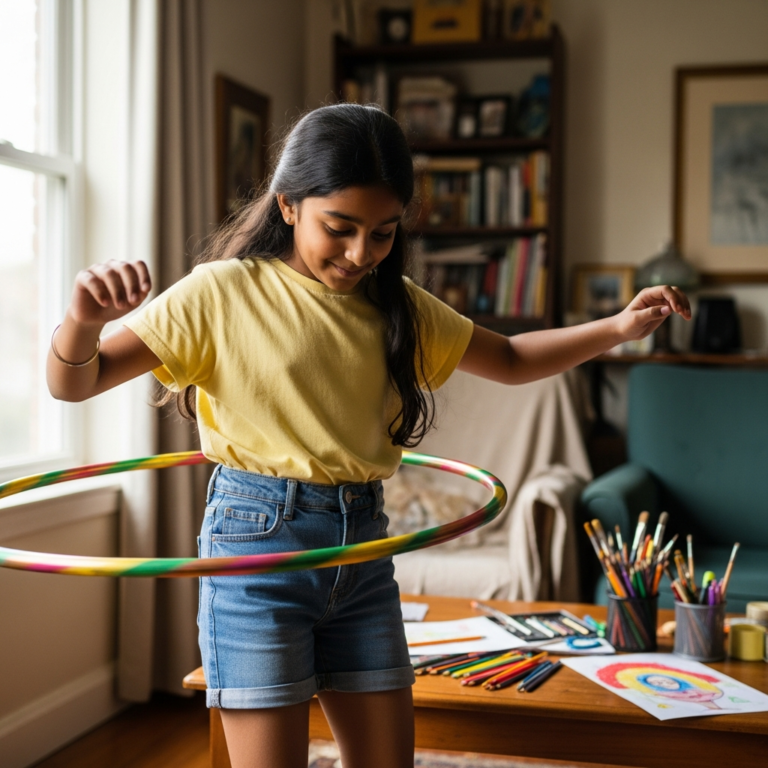
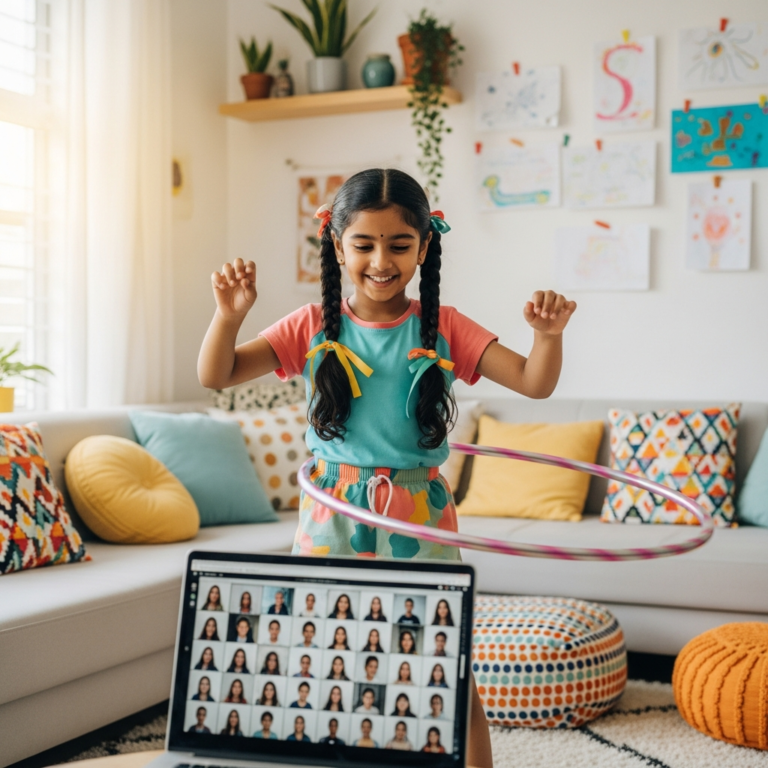
What surprised her family most was how quickly the hoop became a tool for self-expression. Hiyana started pairing her spins with her favourite songs, experimenting with how she moved her arms, and asking her parents to watch her “shows” in the living room after dinner. The hoop was no longer just equipment — it was part of how she communicated.
If you’re curious about what the early stages of learning look like for kids, our guide to fun hula hoop exercises for kids walks through the kinds of movements children work on in their first weeks.
From Shy Moments to Standing Tall
Hiyana had always been expressive at home, but in group settings she could be hesitant — watching others before joining in, hanging back during the more performative parts of class. Her mum noticed a shift around the six-week mark. Hiyana started volunteering to go first. She stopped looking to her parents for reassurance mid-session and started looking to her coach for the next challenge instead.
This kind of progression is something Hoopstar Academy sees regularly. Sanvi’s journey from shy to shining star follows a remarkably similar arc — a child who needed time to trust herself, and found that confidence through consistent practice and a supportive environment.
For Hiyana, the turning point came when she successfully kept the hoop going for a full minute without stopping — a goal she had set for herself. She ran to tell her mum immediately. It was a small milestone by any external measure, but for her it was proof that persistence worked.
What Her Family Noticed at Home
One of the unexpected benefits of hula hooping, according to Hiyana’s parents, was what happened to her screen time. On days when she practised — even just for fifteen minutes in the garden — she was noticeably less drawn to the tablet. The physical exertion seemed to satisfy something that passive entertainment could not.
This is a pattern many parents report. If you’re thinking about the broader impact of active movement on children’s habits, our post on how active movement changes children’s relationship with screens explores the research behind this and what families have found in practice.
Her parents also noticed she was sleeping better, focusing more easily on tasks that required patience, and — perhaps most visibly — carrying herself differently. The posture work embedded in hula hooping had made a quiet physical difference.
A Story That Echoes Many Others
Hiyana’s experience is one we have seen reflected across many of our students. Vedanshi’s hula hooping journey shares that same quality of a child discovering a passion they didn’t know they were looking for. Nayna’s story focuses specifically on how the art of hula hooping became a source of genuine self-confidence over time.
What connects these children is not natural talent — it is the combination of a supportive space, patient coaching, and the particular magic of an activity that rewards creativity as much as technique. Parents who have watched the transformation describe it in strikingly similar terms. This parent testimonial captures that experience in their own words, if you want to hear it directly from a family who has been through the journey.
Is Hoopstar Academy Right for Your Child?
If your child has energy to spare, a love of music, or just needs an activity that feels fun rather than like another scheduled obligation, hula hooping is worth exploring. Hoopstar Academy works with children from age 3 upward, and no prior experience or fitness level is required — only a willingness to give it a go.
To find out more or to book a trial session, visit Hoopstar Academy and see what your child might discover about themselves when they pick up a hoop for the first time.
Follow us on Instagram to see more student stories, progress videos, and a peek into what classes actually look like week to week.
Frequently Asked Questions
What age can children start hula hooping at Hoopstar Academy?
Hoopstar Academy welcomes children from around age 3 upward. Younger children work with lighter, slightly larger hoops designed for smaller bodies, and sessions are structured to match shorter attention spans. Hiyana began at age 4 and took to it immediately, but every child moves at their own pace.
Does my child need any prior experience in gymnastics or dance?
Not at all. While children like Hiyana who have a background in movement may feel comfortable quickly, hula hooping is genuinely accessible to beginners. The fundamentals are taught step by step, and coaches are experienced at working with children who have never tried it before.
How long does it typically take to see progress?
Most children start keeping the hoop going consistently within the first two to four weeks of regular practice. Visible confidence gains — the kind Hiyana’s parents noticed — often follow within six to eight weeks. That said, every child is different, and the process is as valuable as the milestones.
Can hula hooping replace other physical activities, or does it work alongside them?
Hula hooping works beautifully alongside other activities. Hiyana continued with gymnastics and swimming while attending Hoopstar Academy. The core strength, coordination, and rhythm developed through hula hooping can actually complement activities like dance, gymnastics, and sport — they reinforce rather than compete with each other.